
Aging in Place · Raleigh, Cary & the Triangle
Aging in place starts with a home that works as well as you do.
Serving Raleigh, Durham, Cary, Apex, Wake Forest, Garner and Holly Springs.
The stairs you never used to think about. A tub that’s a little harder to step over. A hallway that’s darker than it should be at night. None of it means it’s time to move. It usually means your home needs a few thoughtful changes, and someone who knows which ones actually matter.
Our Aging-in-Place Assessment looks at your home through the lens of safety, accessibility and everyday ease, then gives you a clear, prioritized plan. What you do with it, and when, is entirely up to you.
Guided by 30+ years of construction experience and led by a Certified Aging-in-Place Specialist (CAPS).
What does “aging in place” mean?
Aging in place means continuing to live in your own home safely, comfortably and independently as you get older, rather than moving because the house no longer fits your needs.
It’s what most people want. In AARP’s 2024 Home and Community Preferences Survey, three out of four adults 50 and older said they want to stay in their current homes as they age. Planning for it doesn’t mean something is wrong. It means you’re making sure your home keeps up with the life you want to keep living in it.
In practice, aging in place comes down to three things: a home that’s safe to move around in, accessible where it needs to be, and easy to use every day, plus someone keeping up with the maintenance that gets harder to do yourself.
We assess the home itself
An Aging-in-Place Assessment isn’t a medical visit or a test of what you can and can’t do. We talk with you about how you use your home and what you want to keep doing in it, and then we look at the house: entrances, stairs, bathrooms, lighting, floors, doors and the everyday things you reach for.
If you’re already working with an occupational therapist, that works well together. With your permission, our technician can collaborate with your therapist to help carry out the changes they recommend for your home.
Gold Leaf Home Management does not provide medical or occupational therapy evaluations, and this collaboration does not replace those professional services.
What we look at
Safety, accessibility and ease of use, room by room
Entrances and steps
Step heights, handrails, lighting at the door, and whether there’s a way in without steps if you ever need one.
Bathrooms
Getting in and out of the tub or shower, places a grab bar would help, toilet height, slip resistance and reachable storage.
Stairs and hallways
Handrails on both sides, even treads, clear paths and light switches where you need them, at the top and the bottom.
Lighting
Dark hallways, entries and stairs, night lighting between the bedroom and bathroom, and switches you can find without searching.
Floors and transitions
Loose rugs, raised thresholds, worn carpet and changes in floor height that are easy to catch a toe on.
Doors, handles and controls
Door hardware, faucet handles, cabinet pulls and thermostats that are easy to grip and read.
Kitchen and storage
How much reaching, bending and climbing everyday tasks take, and where a small change would save a step stool.
Safety systems
Smoke and carbon monoxide detectors, water shutoff access and anything else that matters most in an unexpected moment.
Want to start on your own first? AARP’s free HomeFit Guide is a good place to begin. When you’d like a trained set of eyes on your specific home, we’re here.
AARP HomeFit GuideHow an Aging-in-Place Assessment works
What it costs
Whole-home assessment: $249, introductory rate $199
Every area of the home, about 90 to 120 minutes depending on the size of the house.
Focused assessment: $99
Up to two rooms or areas, about 45 to 60 minutes. Additional areas are $50 each during the same visit.
Repairs, installations and detailed design work are quoted separately. The Aging-in-Place Assessment is a separate service from the $129 Home Wellness Assessment, and the fee isn’t credited toward a Home Wellness Membership.
Request an Aging-in-Place AssessmentAn Aging-in-Place Assessment focuses on home features and practical modification recommendations. Gold Leaf Home Management does not provide medical or occupational therapy evaluations, and this service does not replace them. Gold Leaf Home Management is not a licensed home inspection company.
How we prioritize what we find
Not every recommendation is urgent, and not every one needs a contractor. We sort what we find into three simple groups so you can see the whole picture at once:
Often the right answer is the smaller one. If a properly anchored grab bar solves the problem, we’ll recommend the grab bar instead of a new bathroom. And we’ll tell you when something doesn’t need to change at all.
You decide if and when anything changes
- Nothing is done without your approval.
- You can make changes all at once, a few at a time, or not at all.
- You’re free to use us, a contractor you already trust, or do some of it yourself.
- Your summary stays yours. Use it now, or come back to it in a year.
It’s your home. Our job is to give you good information and then respect what you decide.
| Aging-in-Place Assessment | Preventive maintenance | Remodeling | |
|---|---|---|---|
| What it is | A one-time walk-through of your home’s safety, accessibility and ease of use | Ongoing seasonal care that keeps your home in good working order | Construction that changes the home, such as a curbless shower, a wider doorway, a ramp |
| What you get | A prioritized written summary with photos | Four Seasonal Home Wellness Visits a year and a report after each one | A finished project |
| How often | Once, and again if your needs change | Year-round | Only when you decide a project is worth it |
| What it costs | $249 whole-home ($199 introductory) or $99 focused | $79 a month, or $948 a year | Quoted per project |
| Who does it | Gold Leaf Home Management | Gold Leaf Home Wellness Membership | A qualified licensed contractor of your choosing |
Many of the most useful changes fall in between: grab bars, handrails, better lighting, lever door hardware. Gold Leaf handles most of those smaller improvements ourselves, quoted individually, with no remodel required. When a project is larger, such as a full bathroom remodel, we’ll refer you to a qualified licensed contractor.
How routine maintenance supports independent living
Some of the first household tasks that get harder are the ones that happen on a ladder or a step stool: changing HVAC filters, testing smoke detectors on high ceilings, clearing gutters. They’re easy to put off, and they’re exactly what a Home Wellness Membership takes care of.
- Filters changed and detectors tested on a schedule, with batteries replaced once a year, so you don’t have to climb for them
- Gutters cleared in spring and fall from safe access points
- Small issues (a loose rail, a sticking door, a drip) caught early and noted in your report
- The same technician whenever possible, so the person at your door is someone you know
Many homeowners start with an Aging-in-Place Assessment to plan the bigger picture, then add a membership to keep up with the house from season to season.
See what the Home Wellness Membership includes
For adult children and families
Helping a parent stay in their home
If you live across town or across the country, it’s hard to know how a parent’s house is really doing. With your parent’s permission, we can send you a copy of each report, so you see the same photos and notes they do.
- The homeowner decides who receives reports, and can change that at any time.
- We ask the homeowner to sign a short authorization form before we share anything.
- You’re welcome to join the assessment conversation in person or by phone.
- You can request an assessment for a parent, and we’ll confirm directly with them before scheduling.
Our founder started Gold Leaf after years of helping keep up with his own parents’ home. We know what it’s like to want to help from a distance.
Request an assessment for a parentCAPS training, backed by 30 years of building
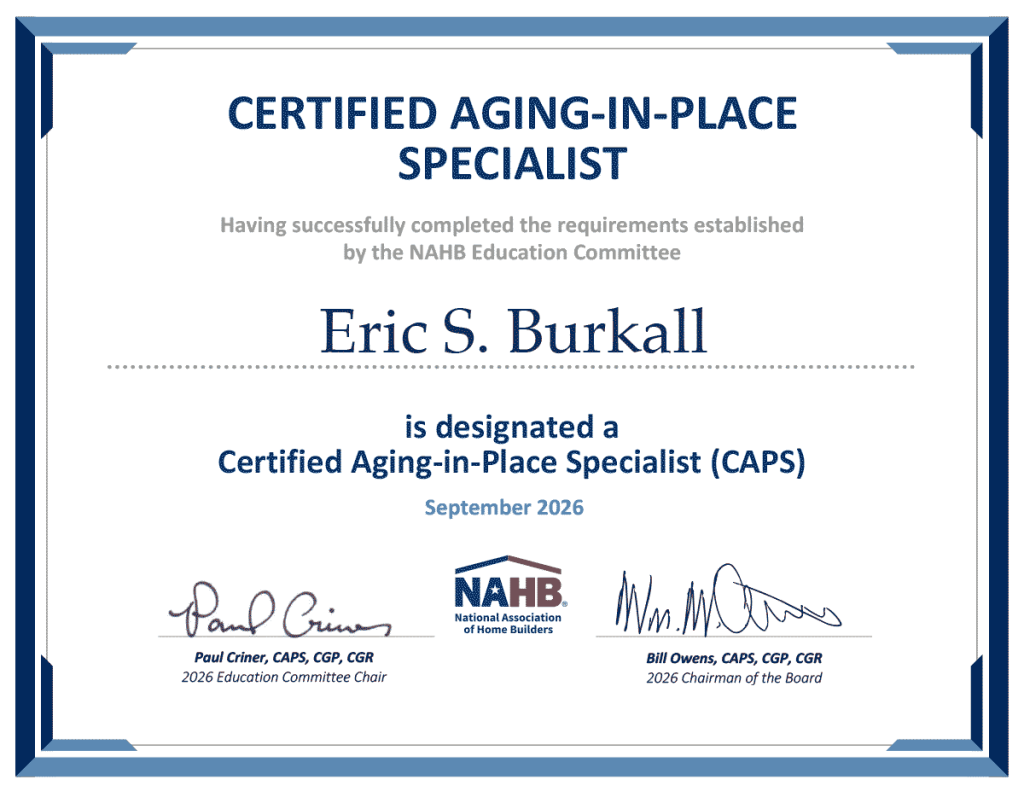
Our founder, Eric Burkall, is a Certified Aging-in-Place Specialist (CAPS), designated by the National Association of Home Builders in 2026, and has spent more than 30 years in residential construction.
That combination matters. CAPS training covers how homes can be adapted so people can live in them safely and comfortably as their needs change. Three decades of building means knowing what a change really involves: what it costs, what it disturbs, and when a simpler fix will do the same job. Sometimes the most useful thing we can tell you is that you don’t need a remodel.
Frequently asked questions
What is a Certified Aging-in-Place Specialist (CAPS)?
A Certified Aging-in-Place Specialist is someone who has completed the CAPS program from the National Association of Home Builders, which covers how to evaluate and adapt homes so people can live in them safely and comfortably as their needs change. You can look up CAPS professionals in NAHB’s online directory.
How is this different from an occupational therapist’s home safety evaluation?
An occupational therapist evaluates how a person moves and functions and recommends changes based on their health needs. It’s a clinical service, often ordered by a doctor. Our assessment focuses on the home itself: its safety, accessibility and ease of use. We don’t provide medical or occupational therapy evaluations, and we don’t replace them. If you’re already working with a therapist, we’re glad to collaborate with them, with your permission, to carry out the changes they recommend.
How much does an Aging-in-Place Assessment cost?
A whole-home assessment is $249, currently offered at an introductory rate of $199, and takes about 90 to 120 minutes. A focused assessment covering up to two rooms or areas is $99 and takes about 45 to 60 minutes, with additional areas at $50 each during the same visit. Any improvements you decide to make are quoted separately, and you’re never obligated to make them.
Is the Aging-in-Place Assessment part of the Home Wellness Membership?
No. It’s a separate service with its own fee, and the fee isn’t credited toward a membership. Many homeowners do both: the assessment plans the bigger picture, and the membership keeps up with the house season to season.
Do I have to make the changes you recommend?
No. Every recommendation is yours to act on, schedule later or skip. We prioritize what we find so you can make informed choices, and nothing is done without your approval.
Can my adult children receive the summary?
Yes, with your permission. You decide who receives it and can change that at any time. We’ll ask you to sign a short authorization form before we share anything.
Can I request an assessment for my parent?
Yes. Tell us a little about your parent’s home when you reach out. We’ll talk with your parent directly and schedule only with their agreement.
Does Medicare pay for grab bars or home modifications?
Original Medicare generally doesn’t cover grab bars or home modifications. Some Medicare Advantage plans offer limited coverage for bathroom safety items, so it’s worth checking your plan’s supplemental benefits. Medicare.gov and your plan provider are the best sources for your specific coverage.
Is there local help for home modifications in Wake County?
Yes. Resources for Seniors, a Wake County nonprofit, offers home modification help, such as ramps and grab bars, for eligible residents 60 and older. The Central Pines Area Agency on Aging can also point you to programs in your county.
Is aging in place better than moving?
It depends on the person and the home. For many people, staying put with a few well-chosen changes is the most comfortable option, and often less disruptive than a move. An assessment gives you real information about what staying would take, so you can make that decision with confidence.
Stay in the home you love, on your terms.
Start with an Aging-in-Place Assessment. You’ll get a clear, prioritized plan from someone who knows homes, and the freedom to decide what happens next.